
Today Islamic Date in Pakistan
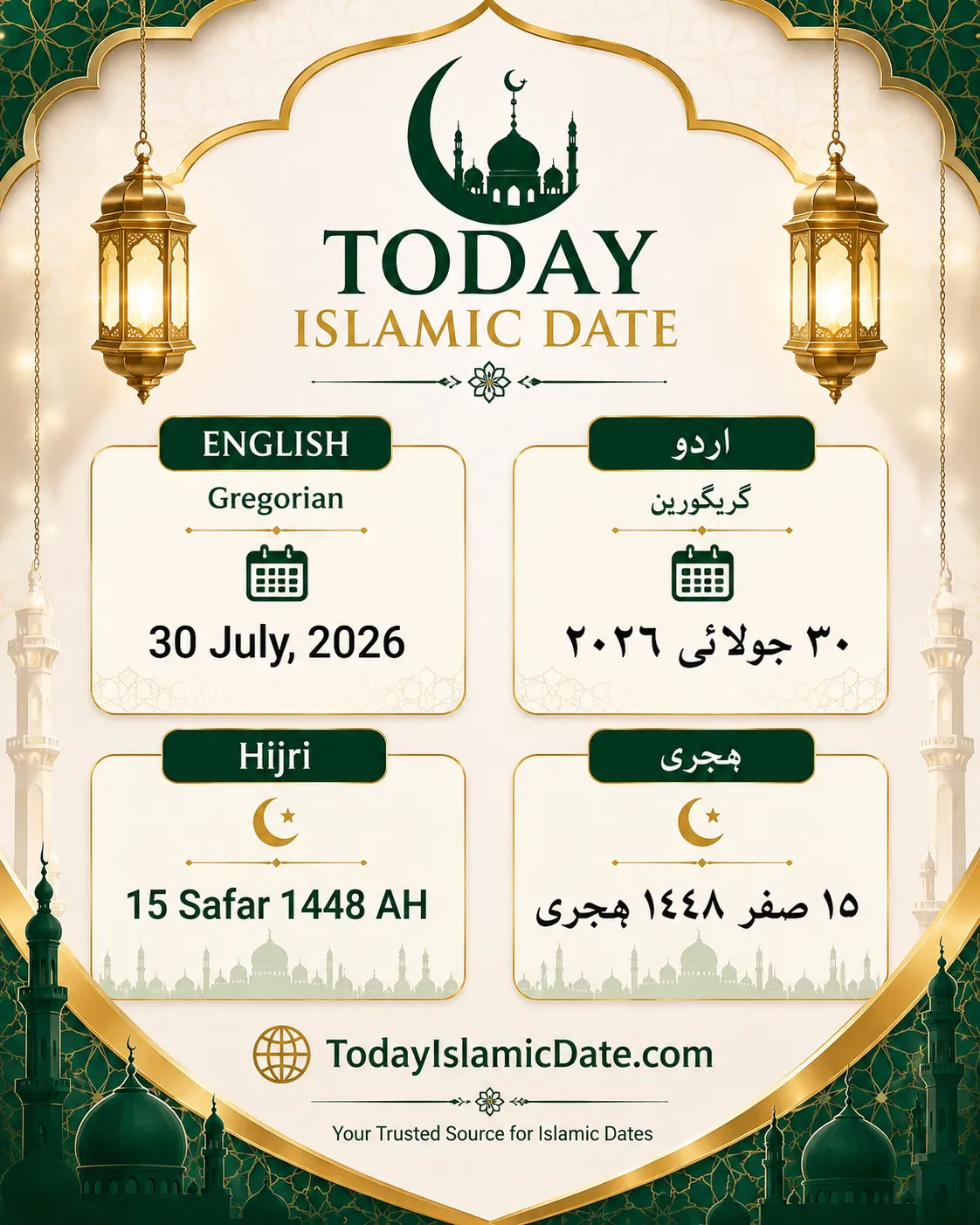
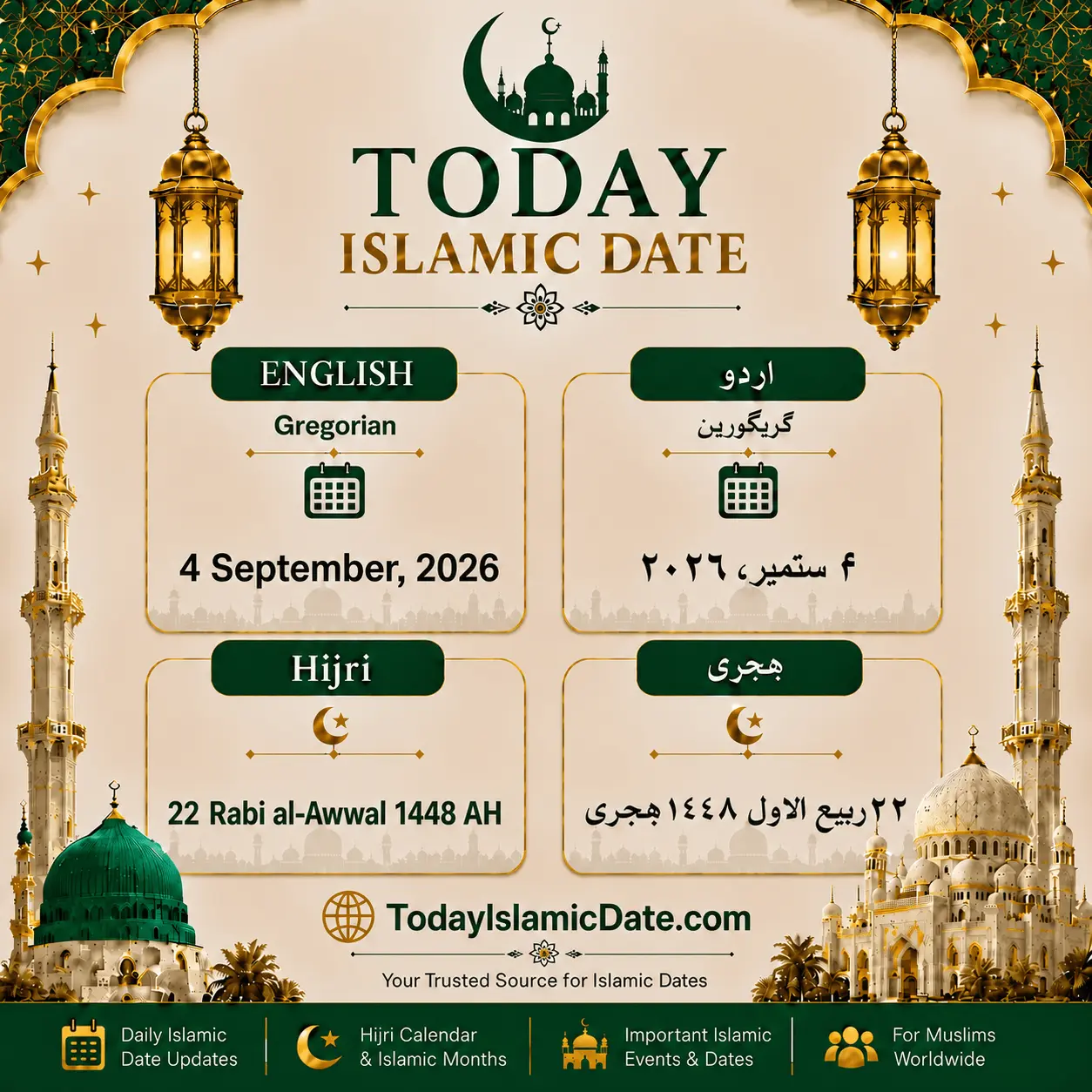
Today Islamic date in Pakistan is 28 Rabi al-Awwal 1448 AH, corresponding to September 11, 2026 (Gregorian). Updated daily for accurate Hijri calendar information. View today’s Gregorian date, Islamic month, year, and upcoming Islamic events.
Pakistan Islamic Calendar
Today Islamic Date Converter
Hijri to Gregorian and Gregorian to Hijri Date Converter makes it easy to convert dates between the Islamic (Hijri) calendar and the Gregorian calendar. Whether you want to find today’s Islamic date, check the Hijri date for an important event, or convert a Gregorian date to its Islamic equivalent, this free online tool provides quick and accurate results in just a few clicks.
The Gregorian to Hijri Date Converter helps you convert any Gregorian date into the corresponding Hijri date. This is useful for finding the Islamic date of birthdays, anniversaries, Ramadan, Eid ul-Fitr, Eid ul-Adha, Hajj, Ashura, and other important religious occasions. Simply select the Gregorian year, month, and day, then click Convert Now to see the equivalent Hijri date.

Today Hijri Date in Major Cities of Pakistan
Check daily updated Islamic dates for key cities across Pakistan.
Islamic Date Today Karachi
SindhKarachi is Pakistan’s largest city and home to millions of Muslims who follow the Hijri calendar for prayers, fasting, and Islamic celebrations. Visit this page daily to check the latest Hijri date in Karachi and stay updated with the Islamic calendar and upcoming religious occasions.
Islamic date today in Karachi is 8 Rabi' al-Thani 1448 AH (٨ ربیع الثانی ١٤٤٨ ہجری). The corresponding Gregorian date is September 20, 2026 (Sunday).
Islamic Date Today Lahore
PunjabLahore is the cultural and historical heart of Pakistan with a rich Islamic heritage. Our daily updated Hijri calendar helps you keep track of the current Islamic date, month, and important events throughout the year.
Islamic date today in Lahore is 8 Rabi' al-Thani 1448 AH (٨ ربیع الثانی ١٤٤٨ ہجری). The corresponding Gregorian date is September 20, 2026 (Sunday).
Islamic Date Today Islamabad
Capital CityIslamabad, the capital of Pakistan, follows the Hijri calendar for many religious and official occasions. Check this page every day for the latest Hijri date and important Islamic calendar updates.
Islamic date today in Islamabad is 8 Rabi' al-Thani 1448 AH (٨ ربیع الثانی ١٤٤٨ ہجری). The corresponding Gregorian date is September 20, 2026 (Sunday).
Islamic Date Today Faisalabad
PunjabFaisalabad is one of Pakistan’s largest industrial cities, where Muslims observe the Hijri calendar for worship and Islamic events. Stay informed with our accurate daily Hijri calendar updates and never miss an important Islamic occasion.
Islamic date today in Faisalabad is 8 Rabi' al-Thani 1448 AH (٨ ربیع الثانی ١٤٤٨ ہجری). The corresponding Gregorian date is September 20, 2026 (Sunday).
Islamic Date Today Rawalpindi
PunjabRawalpindi is a historic city with a large Muslim population that follows the Islamic calendar throughout the year. Our website provides reliable daily Hijri calendar updates for prayers, fasting, and Islamic events.
Islamic date today in Rawalpindi is 8 Rabi' al-Thani 1448 AH (٨ ربیع الثانی ١٤٤٨ ہجری). The corresponding Gregorian date is September 20, 2026 (Sunday).
Islamic Date Today Multan
PunjabMultan, known as the City of Saints, has deep Islamic traditions and historical importance. Visit our page daily to check the latest Hijri date and stay connected with the Islamic calendar.
Islamic date today in Multan is 8 Rabi' al-Thani 1448 AH (٨ ربیع الثانی ١٤٤٨ ہجری). The corresponding Gregorian date is September 20, 2026 (Sunday).
Islamic Date Today Peshawar
KPKPeshawar is one of the oldest cities in Pakistan with a rich Islamic history. Our daily updated Hijri calendar helps you stay informed about today’s Islamic date and upcoming religious events.
Islamic date today in Peshawar is 8 Rabi' al-Thani 1448 AH (٨ ربیع الثانی ١٤٤٨ ہجری). The corresponding Gregorian date is September 20, 2026 (Sunday).
Islamic Date Today Quetta
BalochistanQuetta, the capital of Balochistan, is home to a vibrant Muslim community that follows the Hijri calendar every day. Check the latest Hijri date and important Islamic calendar updates on this page.
Islamic date today in Quetta is 8 Rabi' al-Thani 1448 AH (٨ ربیع الثانی ١٤٤٨ ہجری). The corresponding Gregorian date is September 20, 2026 (Sunday).
Islamic Date Today Sialkot
PunjabSialkot is internationally recognized for its manufacturing industry and strong Islamic traditions. Our website provides accurate daily Hijri calendar updates to help you stay informed about the current Islamic date and major religious occasions.
Islamic date today in Sialkot is 8 Rabi' al-Thani 1448 AH (٨ ربیع الثانی ١٤٤٨ ہجری). The corresponding Gregorian date is September 20, 2026 (Sunday).
Islamic Date Today Hyderabad
SindhHyderabad is one of the major cities in Sindh, where Muslims observe the Hijri calendar for daily worship and Islamic celebrations. Visit this page daily to check the latest Hijri date in Hyderabad and stay updated with important Islamic events, religious observances, and the current Hijri calendar.
Islamic date today in Hyderabad is 8 Rabi' al-Thani 1448 AH (٨ ربیع الثانی ١٤٤٨ ہجری). The corresponding Gregorian date is September 20, 2026 (Sunday).
Islamic (Hijri) Months
Muharram
محرّم 02Safar
صفر 03Rabi’ al-Awwal
ربیع الاوّل 04Rabi’ al-Thani
ربیع الثانی 05Jumada al-Awwal
جمادی الاوّل 06Jumada al-Thani
جمادی الثانی 07Rajab
رجب 08Sha’ban
شعبان 09Ramadan
رمضان 10Shawwal
شوّال 11Dhul Qa’dah
ذو القعدۃ 12Dhul Hijjah
ذو الحجّہIslamic Date Today in Pakistan
If you are looking for the Islamic date today in Pakistan, you are in the right place. Our website provides the current Islamic date, also known as the Hijri date today, along with the Gregorian date. The information is updated daily to help Muslims stay informed about the correct date according to the Islamic calendar.
The Islamic calendar plays an important role in the lives of Muslims. It is used to determine the dates of important religious events such as Ramadan, Eid ul-Fitr, Eid ul-Adha, Ashura, and Hajj. Unlike the Gregorian calendar, which is based on the movement of the sun, the Islamic calendar follows the phases of the moon. This is why the Islamic month date today changes after the sighting of the new crescent moon.
Many people search for today Islamic date, Islamic date, or today Islamic date in Pakistan to check the exact Hijri date before planning religious activities, observing fasts, or celebrating Islamic occasions. Since the Hijri calendar is lunar, each Islamic month begins when the new moon is officially sighted. As a result, the Islamic date may vary from one country to another depending on local moon sightings.
How Is Today Islamic Date Determined?
The Hijri date today is determined by observing the new crescent moon. In Pakistan, the official announcement is made by the Ruyat-e-Hilal Committee, which carefully examines moon sighting reports from different parts of the country. Religious scholars and astronomy experts work together to confirm the beginning of each new Islamic month.
Once the moon is confirmed, the new Hijri month officially begins after sunset. If the moon is not visible due to weather conditions or other reasons, the current Islamic month usually completes 30 days before the next month starts.
This traditional method has been followed by Muslims for centuries and remains an essential part of the Islamic calendar.
The Hijri Calendar Explained
The Hijri calendar, also called the Islamic calendar, began with the migration (Hijrah) of Prophet Muhammad (ﷺ) from Makkah to Madinah in 622 CE. This historic event marks the starting point of the Islamic calendar.
Each month consists of either 29 or 30 days, making the Hijri year approximately 354 or 355 days long. This is about 10 to 11 days shorter than the Gregorian calendar, which is why Islamic months move through different seasons over time.
Difference Between the Hijri and Gregorian Calendars
One of the biggest differences between the two calendars is how they are calculated.
The Gregorian calendar follows the Earth’s journey around the sun and has 365 days in a normal year. It is used worldwide for business, education, and civil purposes.
The Hijri calendar, on the other hand, follows the lunar cycle. It is based on the appearance of the new moon and is primarily used for Islamic religious events. Because the lunar year is shorter, important occasions like Ramadan and Eid occur about 10 to 11 days earlier each year in the Gregorian calendar.
Why Can the Islamic Date Be Different in Other Countries?
You may notice that the current Islamic date is sometimes different in Saudi Arabia, the UAE, India, Bangladesh, or other countries. This happens because every country follows its own moon sighting system. Some countries rely on local moon sightings, while others also use astronomical calculations.
In Pakistan, the official Islamic date today Pakistan is announced after confirmation by the Ruyat-e-Hilal Committee. This ensures that Muslims across the country observe important Islamic events on the same date.
Why Check Today Islamic Date?
Knowing the today Islamic date in Pakistan is useful for many reasons. Muslims use it to keep track of daily worship, voluntary fasting, Islamic anniversaries, and upcoming religious occasions. It also helps families, students, and travelers stay informed about the current Hijri month throughout the year.
 TodayIslamic Date in Saudi Arabia
 Islamic Date Today UAE
 Islamic Date Today India
 Islamic Date Today Bangladesh
 Islamic Date Today Indonesia
 Islamic Date Today Malaysia
 Islamic Date Today Turkey
 Islamic Date Today Qatar
 Islamic Date Today Kuwait
 Islamic Date Today Oman
 Islamic Date Today Bahrain
 Islamic Date Today Egypt
 Islamic Date Today Jordan
 Islamic Date Today Iraq
 Islamic Date Today Iran
 Islamic Date Today Syria
 Islamic Date Today Lebanon
 Islamic Date Today Yemen
 Islamic Date Today Palestine
 Islamic Date Today Afghanistan
 Islamic Date Today Uzbekistan
 Islamic Date Today Kazakhstan
 Islamic Date Today Kyrgyzstan
 Islamic Date Today Tajikistan
 Islamic Date Today Turkmenistan
 Islamic Date Today Azerbaijan
 Islamic Date Today Maldives
 Islamic Date Today Brunei
 Islamic Date Today Singapore
 Islamic Date Today Thailand
 Islamic Date Today Philippines
 Islamic Date Today Sri Lanka
 Islamic Date Today Nepal
 Islamic Date Today United Kingdom
 Islamic Date Today United States
 Islamic Date Today Canada
 Islamic Date Today Australia
 Islamic Date Today New Zealand
 Islamic Date Today Germany
 Islamic Date Today France
 Islamic Date Today Netherlands
 Islamic Date Today Belgium
 Islamic Date Today Switzerland
 Islamic Date Today Sweden
 Islamic Date Today Norway
 Islamic Date Today Morocco
 Islamic Date Today Algeria
Important Islamic Dates
Discover the most important Islamic holidays, events, and observances with their Hijri and Gregorian dates in Pakistan.
Islamic New Year
1 Muharram 1448 AH June 17, 2026Beginning of the Islamic lunar year and the month of Muharram.
Day of Ashura
10 Muharram 1448 AH June 26, 2026A blessed day observed with fasting and remembrance.
12 Rabi ul Awwal
12 Rabi I 1448 AH August 26, 2026Many Muslims commemorate the birth of Prophet Muhammad ﷺ.
Shab e Miraj
27 Rajab 1448 AH January 16, 2027The Night Journey and Ascension of Prophet Muhammad ﷺ.
Shab e Barat
15 Sha’ban 1448 AH February 3, 2027A night dedicated to worship, repentance, and prayers.
Ramadan Begins
1 Ramadan 1448 AH February 18, 2027The holy month of fasting, prayer, and spiritual reflection.
Laylat al-Qadr
27 Ramadan 1448 AH March 15, 2027The Night of Power, one of the holiest nights in Islam.
Eid ul Fitr
1 Shawwal 1448 AH March 20, 2027The festival celebrating the completion of Ramadan.
Day of Arafah
9 Dhul Hijjah 1448 AH May 16, 2027One of the most significant days of worship in Islam.
Eid ul Adha
10 Dhul Hijjah 1448 AH May 17, 2027The Festival of Sacrifice honoring Prophet Ibrahim (AS).
Hijri Calendar vs Gregorian Calendar
The Hijri Calendar and the Gregorian Calendar are the two most commonly used calendar systems in the world. While both are used to measure time, they are based on different astronomical cycles and serve different purposes.
The Hijri Calendar, also known as the Islamic calendar, is a lunar calendar that follows the phases of the moon. It contains 12 lunar months and has 354 or 355 days in a year. Muslims use the Hijri calendar to determine important Islamic events such as Ramadan, Eid al-Fitr, Eid al-Adha, Hajj, Ashura, and the Islamic New Year.
The Gregorian Calendar is a solar calendar based on the Earth’s movement around the sun. It contains 365 days in a normal year and 366 days in a leap year. It is the official civil calendar used by most countries worldwide for business, education, government, and daily life.
| Feature | Hijri Calendar | Gregorian Calendar |
|---|---|---|
| Calendar Type | Lunar Calendar | Solar Calendar |
| Days in a Year | 354–355 Days | 365–366 Days |
| Based On | Moon | Sun |
| Number of Months | 12 | 12 |
| Month Length | 29 or 30 Days | 28–31 Days |
| Used For | Islamic Events & Religious Observances | Civil, Business & Government Activities |
| New Year | Islamic New Year (Muharram) | January 1 |
| Main Purpose | Religious Calendar | International Civil Calendar |
Islamic Date History
The Hijri Calendar, also known as the Islamic Calendar, has a rich history that dates back to the early years of Islam. It is more than just a way to count days and months. It represents an important part of Islamic history and helps Muslims determine the dates of religious events throughout the year.
Unlike the Gregorian calendar, which is based on the movement of the sun, the Hijri calendar follows the lunar cycle. Every Islamic month begins with the sighting of the new crescent moon (Hilal), making the calendar closely connected to nature and Islamic traditions.
Today, millions of Muslims around the world use the Hijri calendar to observe Ramadan, Eid al-Fitr, Eid al-Adha, Hajj, Muharram, and other important Islamic occasions.
Origin of the Hijri Calendar
The Hijri calendar began during the time of Hazrat Umar ibn Al-Khattab (RA), the second Caliph of Islam. As the Islamic state expanded, there was a growing need for a unified calendar to organize official documents, letters, legal matters, and important events.
After consulting with the companions of Prophet Muhammad (peace be upon him), Hazrat Umar (RA) approved the creation of the Islamic calendar. Instead of using the Prophet’s birth or the beginning of revelation, the companions agreed that the calendar should start from one of the most significant events in Islamic history—the Hijrah.
The Hijrah
The word Hijrah refers to the migration of Prophet Muhammad (peace be upon him) and his companions from Makkah to Madinah in 622 CE.
This migration marked a turning point in Islamic history. It was not simply a change of location but the beginning of the first Muslim community and the establishment of an Islamic society based on justice, faith, and unity.
Because of its great historical importance, the Hijrah became the starting point of the Islamic calendar. This is why Islamic years are written with AH (Anno Hegirae), which means “In the Year of the Hijrah.”
Why Was the Hijri Calendar Started?
The Hijri calendar was introduced to provide Muslims with a standard way to record dates and organize official matters. Before the Islamic calendar was established, important documents often lacked a consistent date, making it difficult to determine when events had taken place.
By adopting the Hijri calendar, Muslims gained a reliable system for recording historical events, managing government affairs, and determining the dates of religious observances. Today, the Hijri calendar continues to play an important role in the lives of Muslims around the world. It is used to determine the beginning of Ramadan, the dates of Hajj, the celebrations of Eid, and many other important Islamic occasions.
Frequently Asked Questions
Everything you need to know about today’s Islamic date, the Hijri calendar, and date conversions.
What is today’s Islamic date?
Today’s Islamic date is based on the Hijri calendar, which follows the lunar cycle. You can check the current Hijri date on this page, updated according to the latest Islamic calendar calculations.
How is today’s Hijri date calculated?
The Hijri date is calculated using the Islamic lunar calendar. Each month begins with the sighting of the new crescent moon (Hilal). Depending on your country, the official Hijri date may vary slightly due to local moon sightings.
Why does today’s Islamic date differ between countries?
Some countries rely on local moon sightings, while others use astronomical calculations to determine the beginning of Islamic months. Because of this, today’s Hijri date may differ by one day in different regions.
What is the Hijri Calendar?
The Hijri Calendar, also known as the Islamic Calendar, is a lunar calendar consisting of 12 months and 354 or 355 days in a year. It is used to determine important Islamic events such as Ramadan, Eid ul-Fitr, Eid ul-Adha, Hajj, Ashura, and the Islamic New Year.
What is a Hijri to Gregorian Date Converter?
A Hijri to Gregorian Date Converter allows you to convert any Islamic (Hijri) date into its equivalent Gregorian date quickly and accurately.
What is a Gregorian to Hijri Date Converter?
A Gregorian to Hijri Date Converter converts dates from the Gregorian calendar into the Islamic Hijri calendar, making it easy to find the corresponding Islamic date.
How accurate is the Hijri Date Converter?
Our Hijri Date Converter uses reliable Islamic calendar calculations to provide highly accurate results. However, official Hijri dates may vary slightly depending on moon sightings announced by local religious authorities.
Can I convert both past and future dates?
Yes. You can convert historical, current, and future dates between the Hijri and Gregorian calendars using this converter.
Why is the Hijri year shorter than the Gregorian year?
The Hijri calendar follows the moon and contains approximately 354 or 355 days, while the Gregorian calendar follows the sun and contains 365 or 366 days. This difference causes Islamic dates to shift about 10 to 11 days earlier each Gregorian year.
Which calendar is used for Ramadan and Eid?
Ramadan, Eid ul-Fitr, Eid ul-Adha, Hajj, Ashura, and other Islamic events are determined according to the Hijri (Islamic) calendar.
Can I check today’s Islamic date for my country?
Yes. You can view today’s Hijri date for your country. Since moon sightings vary, the Islamic date may differ slightly between regions.
Is this Hijri Date Converter free to use?
Yes. Our Hijri to Gregorian and Gregorian to Hijri Date Converter is completely free to use without registration or subscription.
Can I use this Islamic Date Converter on my mobile phone?
Yes. The converter is fully responsive and works on mobile phones, tablets, laptops, and desktop computers.
What is the difference between the Hijri and Gregorian calendars?
The Hijri calendar is based on the lunar cycle and is used for Islamic religious observances, while the Gregorian calendar is based on the solar year and is the standard civil calendar used worldwide.
How often is today’s Islamic date updated?
Today’s Islamic date is updated regularly based on the current Hijri calendar, ensuring you always see the latest available Islamic date.
Can I use this tool to find Ramadan and Eid dates?
Yes. You can use this tool to check Hijri dates and determine the expected Gregorian dates for Ramadan, Eid ul-Fitr, Eid ul-Adha, Ashura, the Islamic New Year, and other important Islamic events.